


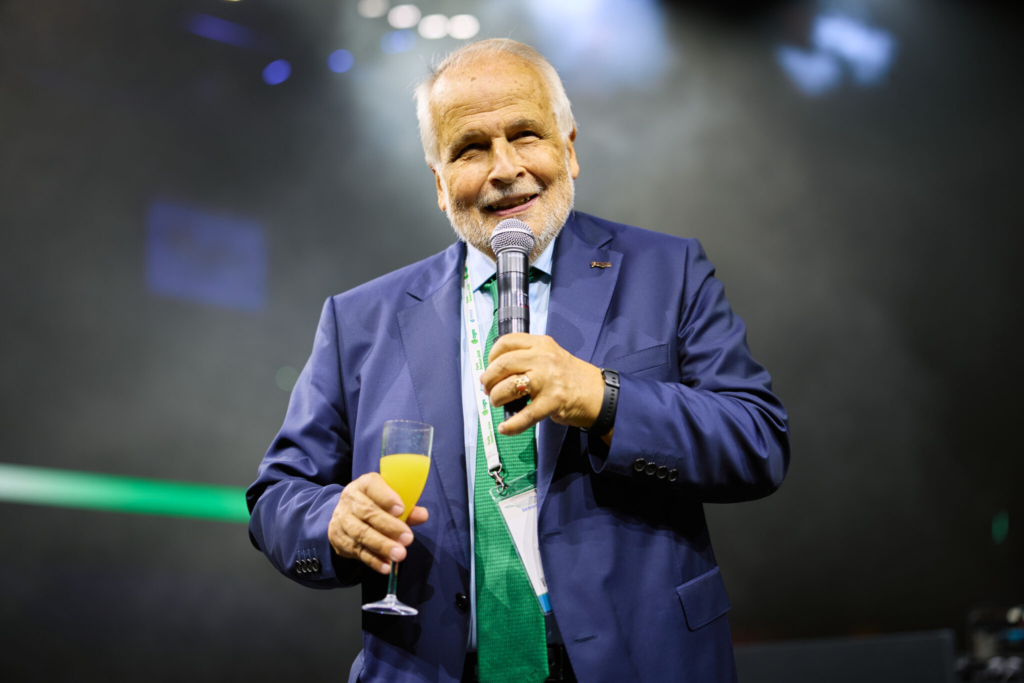
Konstantin Papailiou: ‘There is no plan B’
Konstantin Papailiou is on a mission. GridEx meets the CIGRE President in Paris with the Grecian determined to play his part in overcoming what he views as the sector’s greatest challenge.
If Konstantin Papailiou hadn’t gone into electrical engineering, he would have made an excellent spin doctor. During an hour-long interview with GridEx, the President of CIGRE rolls out self-coined slogans one after another to illustrate his points of view on the energy transition, digitalisation of the grid, and the roles that networks, politicians and the public must play.
There is one message that the charismatic Grecian repeatedly returns to: “there is no plan B, there is no planet B”.
It was also the take home message from his opening speech at CIGRE Paris Session 2026 this August, in which he urged delegates to recognise the magnitude of delivering the energy transition.
Our interview takes place at the end of the conference’s second day, tucked away in a quiet meeting room with the tip of the Eiffel Tower just in view. Papailiou admits to welcoming the chance to sit down having spent much of the preceding 48 hours being mobbed by the conference’s 5,000-plus delegates, all eager to shake the hand of the man at the organisation’s helm. And while you could forgive the former CEO of the Pfisterer Group for being jaded, he quickly perks up when we start talking about his vision for the sector.
Following a summer of extreme weather events across Europe, Papailiou says that working in the energy sector “is not a job anymore […] it is a mission”, pushing one clenched fist into his other hand to emphasise his point.
That mission, however, cannot be achieved by engineers alone, Papailiou stresses. Instead, it must be understood by citizens, regulators, politicians, suppliers, academics and the next generation who need persuading to enter the profession. For that to happen, the grid must become more digital, more flexible and more integrated, but it must also become more visible in public imagination.
Papailiou warns that without that wider understanding, the transition risks being slowed not by a lack of technology, but by a lack of trust, public support and an impending workforce crisis.
Summer of devastation
Papailiou points to recent wildfires across the continent and extreme summer temperatures as the urgent factors driving his mission. At the exact moment we discuss the impact of these extreme weather events, a tornado tore through villages in southern France, devastatingly adding to Papailiou’s catalogue of evidence.
And while such events are currently front-page news, Papailiou is cautious about assuming extreme weather alone will shift opinion. “People have very short memories,” he says. “Tomorrow, something else happens, and they will stop talking about it being 39 degrees.”
For this reason, Papailiou views the energy transition (and by extension the digitalisation of grids) not as a delivery challenge but as a communication challenge – something he says energy networks have ignored for decades, fuelling public resistance.
“I was involved in the business of overhead lines all my life,” Papailiou says. “And for many, many years people have been objecting to them for the same reasons. They are not aesthetic, they ruin the landscape etc. Then there are the pseudo scientists that make claims that they cause cancer or leukaemia to children, which is not true.”
Looking back over his 40-plus year career, Papailiou says that in the past utilities didn’t feel the responsibility to explain the importance of infrastructure projects to the public. However, for him, delivering the energy transition is a “generational obligation”. “Nobody talks about the real war, and we must,” he adds. “The long-term war is the war to save the planet.
“As Barack Obama famously said a few years ago, ‘we are the first generation to feel the impact of climate change, and the last generation that can do something about it’. We cannot leave this to policymakers alone. We have to do it ourselves, for our communities, for our families, and for the world which depends on us.”
Scale of grid expansion challenge
Across Europe, an estimated 8 million kilometres of high voltage overhead lines will be needed by 2040. On top of that another 3-4 million kilometres of lines built across the continent shortly after the Second World War will need upgrading, Papailiou adds: “As James Bond said, only ‘diamonds are forever’, overhead lines are not. So, the utilities, the big TSOs, must spend a lot of money to upgrade which means they need to convince people that it’s necessary to have overhead lines.”
With an unprecedented amount of work required to expand grids, Papailiou says changing that narrative and securing a social mandate to build is essential. However, public buy-in for grid investment will also depend on affordability.
He says that while consumers may understand the climate case for new infrastructure, support will soon dissipate if bills rise to unaffordable levels. Therefore, when it comes to rolling out both physical and digital infrastructure, Papailiou wants energy networks to be realistic about what they need.
“Let’s be honest, we are engineers. If you give us an open chequebook, we’ll design a substation which is AI-driven, gold-plated with a robot dog barking every time a relay operates, and we don’t care how much it will cost to be built,” he says.
“We have to rethink that. We have to rethink our design issues. We have to think about the circular economy. We have to make sure that depreciation models are in place to make electricity affordable, and we cannot rely on subsidies. And we should be technology open […] we cannot be ideologically blunt.”
The key to the affordability question, for Papailiou, requires grid operators, regulators and policymakers to clearly explain to the public how investment reduces longer-term system costs, improves security of supply and unlocks cheaper clean generation. They also need to show how vulnerable customers are protected. “If the transition is perceived as unfair, technical progress will not be enough,” he adds. “The industry’s challenge is to make those benefits concrete without pretending the costs do not exist.
“This should be understood by the people on the street,” Papailiou says. “It is a long-term process, which includes affordability.”
Skills challenge
Alongside the communication challenge is the need to tackle an impending skills shortage. With so much work to do, the CIGRE President believes the only way to attract the next generation of engineers is to tie his mission to save the planet more closely to the energy transition.
“We don’t have qualified people anymore. This is a very big issue,” he says. “To study electrical engineering is definitely more difficult than studying something much simpler, and you do not necessarily earn more money.” The answer, Papailiou argues, is to give the profession “meaning”: “young people need to see grid engineering not only as a technical career but as a climate mission”.
One success Papailiou has already had is convincing his son to follow in his footsteps – however, he also had the help of his wife on that front, who Papailiou met at a CIGRE conference many decades ago.
Digitalisation of the grid will help with the skills challenge, Papailiou believes, however he warns against viewing it as a “magic layer” spread over an old system. “We still have to qualify people to run these projects. They are not running automatically. You need programmers. You need people.”
He adds that the skills gap risks becoming one of the transition’s defining constraints as networks are asked to build faster, operate closer to real time, protect themselves from cyber threats and integrate millions of new devices. At the same time, many utilities are dealing with ageing workforces and competition for digital talent from sectors that may appear more glamorous or better paid.
CIGRE has responded by establishing an Innovation and Education Fund, and Papailiou says the organisation is also looking at how young people talk about engineering on social networks. That matters because recruitment starts before university, he says: “The sector cannot wait until students have already chosen another path. We should start early.”
Changing role of DSOs
For DSOs in particular, digital skills will determine whether they can move from passive asset owners to active system managers. Earlier this year, the European Commission issued a funding call aimed at boosting digital skills for DSOs, and Papailiou believes this will be key to modernising the entire grid.
However, he says the scale of the DSO landscape makes this difficult. Some countries have a handful of large operators, but many others have hundreds or even thousands of small municipal or regional utilities. “In a small country like Switzerland, we have about 600 DSOs,” Papailiou notes. “Germany is the same — thousands of DSOs. It is not so easy.”
The solution, he suggests, will not be to force every small DSO to become a miniature version of a major TSO. Instead, cooperation, shared platforms and shared technical knowledge will be required. “They [DSOs] do not have to develop everything from scratch,” he says. “Maybe 10 companies can share one expensive person who knows about digitalisation. Then each pays one tenth.”
He also believes that the traditional separation between transmission and distribution is breaking down. “When I started as a young engineer, we had dedicated power stations, radial feeds, and there was the meter and the streetlight,” Papailiou says. “This has changed now. We have batteries, EVs, storage, hydrogen, rooftop solar. The system has become bidirectional and it means TSOs and DSOs need to work together more than ever before.”
That shift places new responsibilities on both TSOs and DSOs. At a transmission level, network operators must plan and operate a system where flows are less predictable and stability depends on resources beyond the transmission boundary. DSOs, meanwhile, are no longer passive network companies and they must manage distributed energy resources, congestion, flexibility and customer connections.
Visibility across both systems therefore will be key to both expanding the grid and optimising the existing infrastructure, Papailiou adds. In response to this changing landscape, CIGRE has launched its OneGrid initiative to help facilitate a closer relationship and better data sharing across transmission and distribution. In practice, the OneGrid initiative has been establish to ensure that distribution is clearly represented in the technical work that CIGRE publishes.
Supply chain holds the key
Another major challenge – and major change in the system – is the relationship system operators have with supply chain partners. The grid transition requires transformers, cables, inverters, switchgear, conductors, protection systems, software and specialist labour at an unprecedented scale.
In consequence, uppliers have full order books and can afford to be selective about which networks they work for, meaning procurement models built for an era of buyer power are being challenged.
Papailiou says that he could never have imagined this dynamic when he was starting out in the industry. In the past, he says, the purchasing manager at a utility was “the second level after God”, while suppliers were “trying to survive”. Now, he says, “it is exactly the opposite. They have so many projects that suppliers can choose.”
“Ten years ago, a supplier would be creeping on the ground,” Papailiou jokes, with a wry smile as he reflects on a career largely spent in the supply chain. “Now CEOs understand that we have to think about the supply chain.”
Despite the scale of the challenge, Papailiou is not pessimistic. He sees progress in the way industry leaders now talk about the system as a whole ecosystem.
He also sees support for his solutions: shared expertise for smaller DSOs, stronger TSO-DSO collaboration, digital tools that improve visibility, and better communication with the public.
“There is always a solution to any problem,” he concludes.
